Category: Money Moves Markets

  • Hard landing watch: September surveys

    This is the first of a series of short posts focusing on whether incoming economic news supports or contradicts the forecast of a global “hard landing” suggested by monetary trends. 

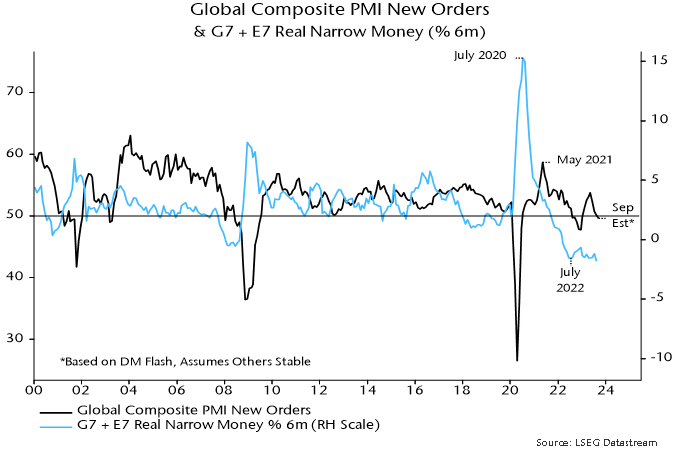
    Flash results suggest that the global composite PMI new orders index – a timely indicator of demand momentum – fell for a fourth month in September, consistent with the monetary signal of a slide into early 2024, at least. 

    The flash results, available for the US, Japan, Eurozone, UK and Australia, imply a decline through 50 to the lowest level since December, assuming no change in all other countries in the global aggregate – see chart 1. 

    Chart 1

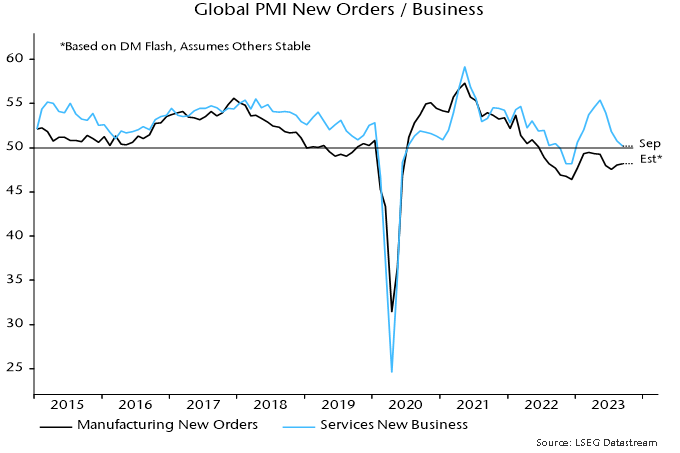
    Weakness in the flash surveys was driven by a further slowdown in services new business, with manufacturing new orders little changed – chart 2.

    Chart 2

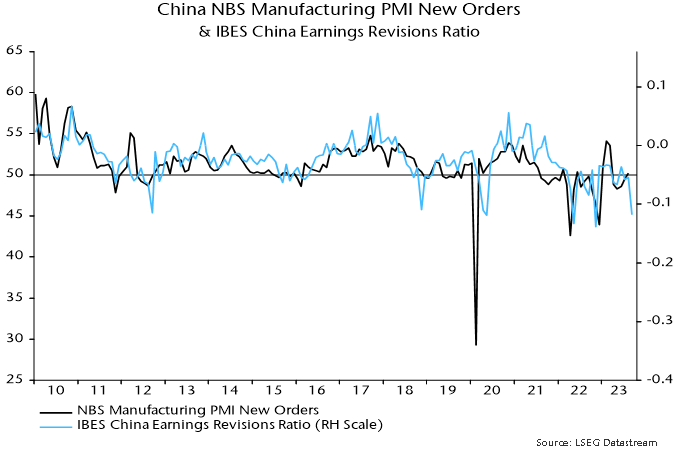
    Any hopes of manufacturing stabilisation, however, may be dashed by full September results incorporating China and other emerging economies. The equity analysts’ earnings revisions ratio correlates with Chinese manufacturing PMI new orders and weakened sharply this month – chart 3. 

    Chart 3

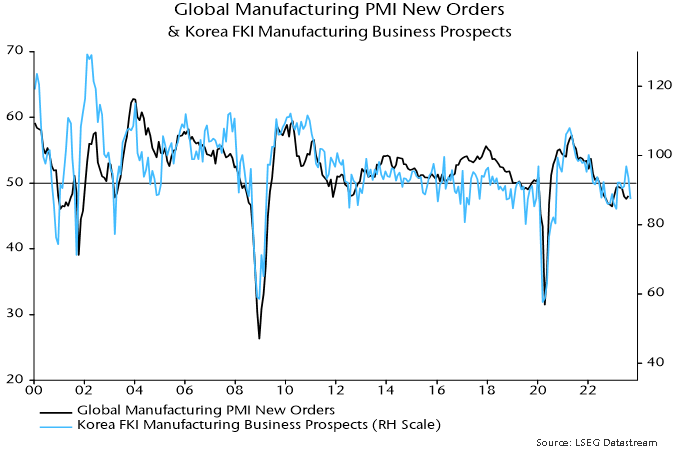
    Renewed deterioration in Chinese / Asian manufacturing is also suggested by the Korean FKI survey for September, showing a relapse in the assessment of business prospects to the weakest since February – chart 4.

    Chart 4

    —–
    COMMENT:
    AUTHOR: Roberto Rosenfeld
    EMAIL: web@kaught.com
    IP: 99.145.175.100
    URL:
    DATE: 09/28/2023 03:01:43 AM

    Thank you for these short posts, Mr. Ward. It's crunch time we are in now.

    —–
    COMMENT:
    AUTHOR: David Cotton
    EMAIL:
    IP: 78.129.191.50
    URL:
    DATE: 09/28/2023 08:56:24 AM

    Hopefully policy makers will take note. Given long end yields and the oil price it seems the monetary squeeze will intensify quite a bit further yet.

    —–
    COMMENT:
    AUTHOR: Emma Wilkinson
    EMAIL: ewilkinson@westburyam.co.uk
    IP: 82.69.37.168
    URL:
    DATE: 09/28/2023 12:47:12 PM

    Thank you Simon , frequent updates more important than ever at the moment!

  • UK labour market data weak not “mixed”

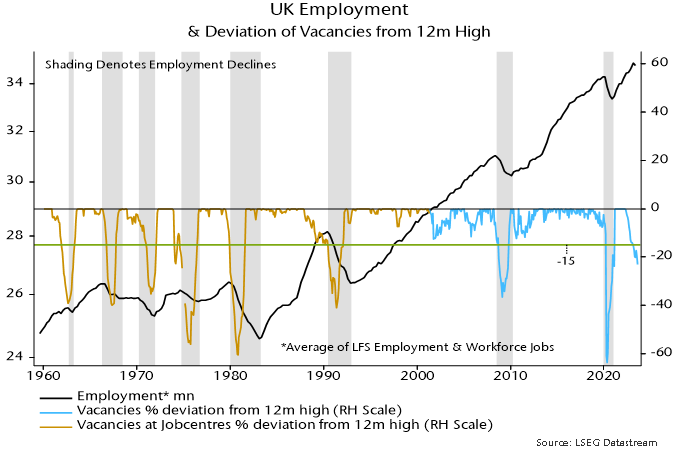
    A post in May suggested that UK employment would embark on a sustained decline in Q2. This was based on the stock of vacancies having fallen 17% from its 12-month peak – declines of more than 15% historically were always associated with sustained employment falls. 

    Labour Force Survey employment fell by 207,000 in the three months centred on June from three months earlier, while the workforce jobs measure (of positions rather than people) was down by 153,000 between March and June. 

    Vacancies have continued to collapse, with the August stock down by 23% from its 12-month high and 29% below the April 2022 peak – see chart 1. 

    Chart 1

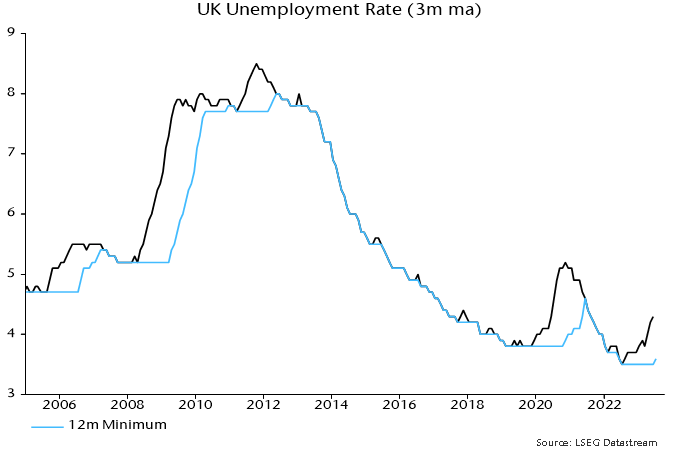
    The three-month average unemployment rate, meanwhile, rose further to 4.3% in July versus an August 2022 low of 3.5%, confirming a Sahm rule recession signal (an increase of more than 0.5 pp from the 12-month minimum) – chart 2. 

    Chart 2

    A July post noted that the Sahm rule has an imperfect record as an indicator of UK recessions but signals were always associated with a slowdown in average earnings growth. 

    Annual growth of regular earnings ticked down from 8.0% in June to 7.8% in July, while median pay growth in the more timely PAYE dataset eased to 6.7% in August – chart 3. (Caveat: the PAYE numbers are subject to significant revision.) 

    Chart 3

    In light of the above, claims that the latest labour market news is “mixed” and shouldn’t deflect the MPC from another rate hike next week are odd and appear to reflect confirmation bias. 

    Money / credit contraction argues that current policy is much too restrictive. The ongoing collapse in vacancies and faster-than-expected deterioration in more lagging labour market indicators are consistent with this interpretation. 

    MPC member Catherine Mann argues for erring on the side of overtightening because rates can be cut swiftly if a mistake becomes apparent. If only the economic damage from bad policy-making were so easily reversed.

    —–
    COMMENT:
    AUTHOR: David Cotton
    EMAIL:
    IP: 78.129.191.50
    URL:
    DATE: 09/14/2023 09:26:56 AM

    The group think between central bank decision makers is remarkable.

    Crucially they seem to have forgotten there is a long and variable lag to policy.

    Once they realise their mistake and ease, it will take 12-18 months to feed through in to monetary aggregates and activity!

    There are enormous medium term downside risks from overtightening.

  • Disastrous European monetary data

    Eurozone / UK July money numbers offer further support to the assessment here that ECB / Bank of England policy tightening has been excessive and – unless reversed swiftly – will cause unnecessarily severe economic weakness and a medium-term inflation undershoot. 

    The latest releases are astonishing in several respects. 

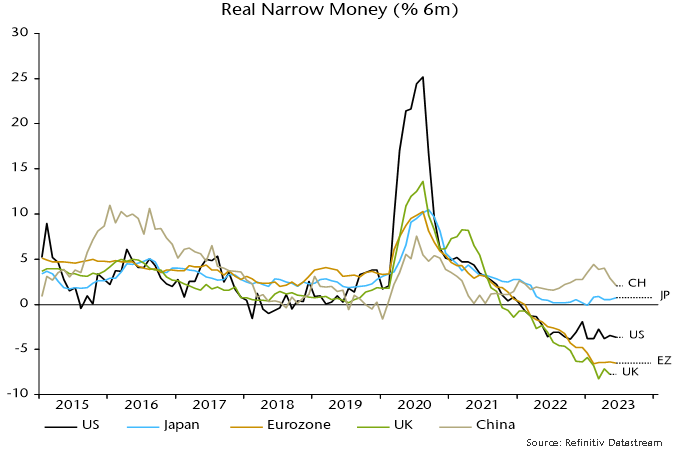
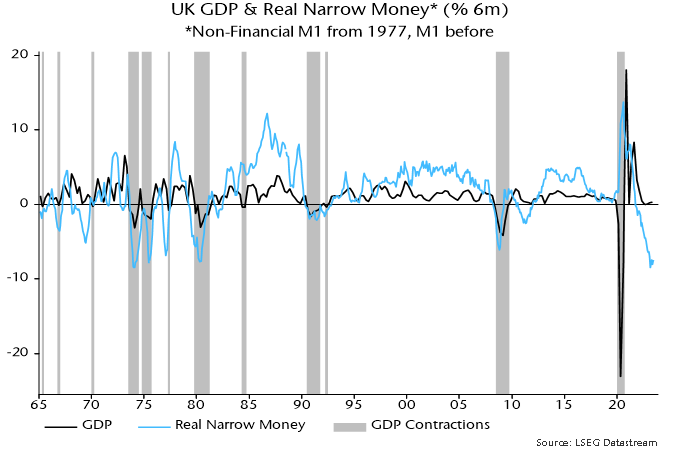
    Six-month real narrow money momentum hit a new low in the Eurozone in July and is even weaker in the UK despite a recent boost from falling six-month CPI inflation. Readings are much worse than elsewhere and historically extreme – see charts 1-3. 

    Chart 1
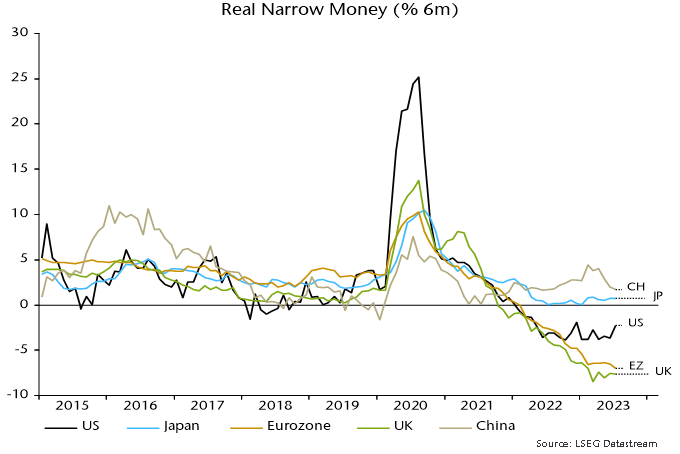
    Chart 2
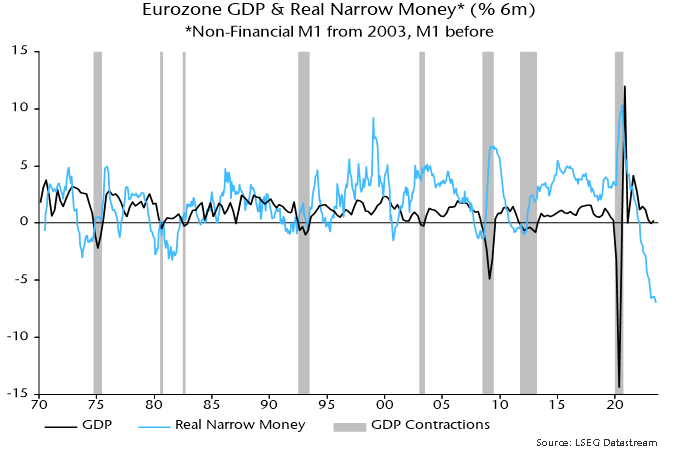
    Chart 3
    Broad money has followed narrow into nominal contraction. The preferred broad measures here, i.e. Eurozone non-financial M3 and UK non-financial M4, fell at annualised rates of 0.8% and 0.9% respectively in the three months to July – charts 4 and 5. 

    Chart 4
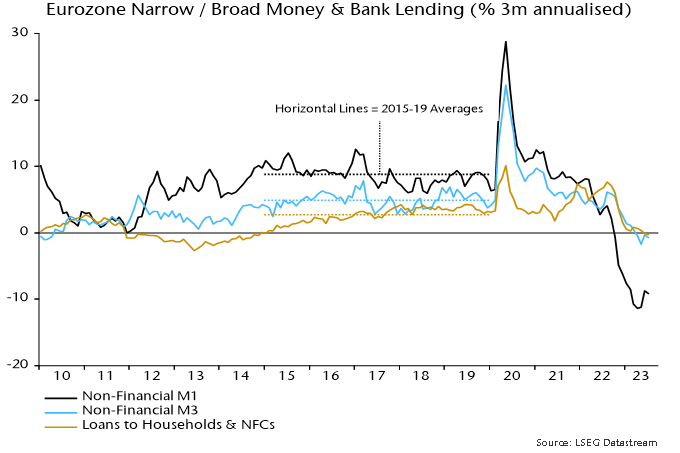
    Chart 5
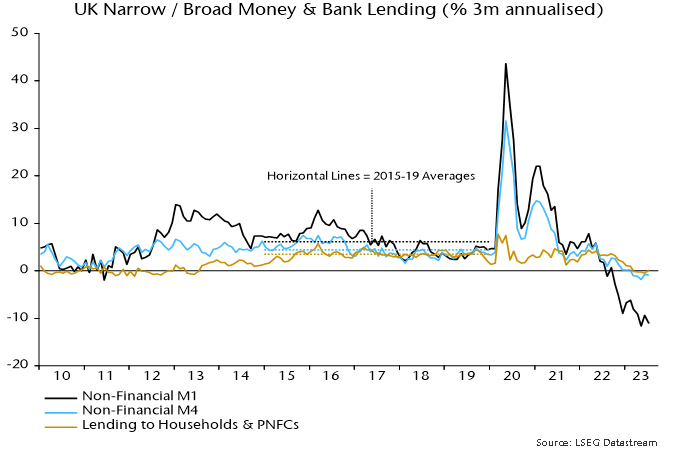
    Broad money declines are rare: since 1970, the Eurozone / UK three-month changes were negative only for a brief period around the GFC, with the falls of similar magnitude to recently. 

    Money leads the economy while credit is coincident / lagging. Bank lending to households and non-financial firms is starting to contract, consistent with recessions being under way – charts 4 and 5. 

    A further notable feature of the Eurozone data is a widening divergence between still-rising bank deposits in Germany and falls elsewhere – chart 6. 

    Chart 6
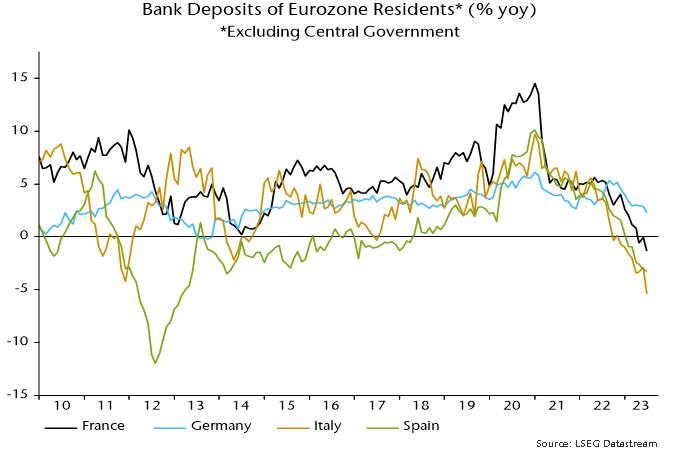
    A similar core / periphery monetary divergence in 2011 warned of an escalating Eurozone crisis. The driver then was capital flight from the periphery, reflected in a ballooning of national central bank TARGET deficits / surpluses. 

    The Bundesbank’s TARGET surplus has fallen recently. Rather than capital flows, the relative resilience of German broad money is explained by less pronounced weakness in bank lending – chart 7. 

    Chart 7
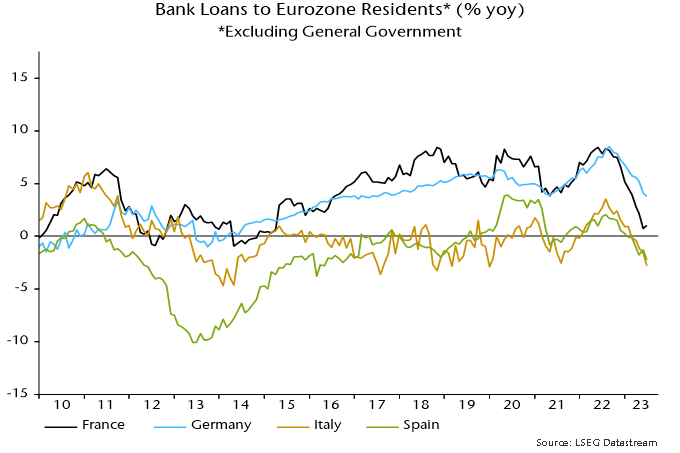
    So money / credit trends suggest that economic prospects in the rest of the Eurozone are at least as bad as in Germany. 

    Eurozone six-month CPI momentum, meanwhile, continues to track a simplistic monetarist forecast based on the profile of broad money growth two years earlier – chart 8. Six-month headline momentum was unchanged at 3.3% annualised in August but core slowed further to 4.0%, a 17-month low. 

    Chart 8
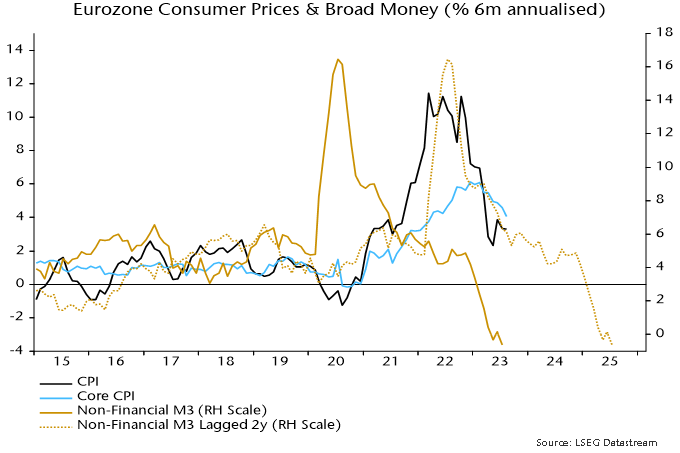
    The suggestion is that six-month headline momentum will reach 2% next spring, with the annual rate following during H2. A subsequent significant undershoot is indicated unless recent monetary weakness is reversed.

    —–
    COMMENT:
    AUTHOR: David Cotton
    EMAIL:
    IP: 78.129.191.50
    URL:
    DATE: 08/31/2023 05:00:19 PM

    Yes, it's hard to imagine anything other than a severe recession from this data. I do think nominal money trends will better represent relative fortunes of economies.

    —–
    COMMENT:
    AUTHOR: Jan Leroy
    EMAIL:
    IP: 178.119.235.25
    URL:
    DATE: 09/02/2023 11:07:25 AM

    Isn't current monetary weakness just the mirror image of the gigantic increase during the lockdowns? So it's negative without any doubt but perhaps not as disastrous for economic growth just as the boom didn't lead to extreme GDP growth?

    —–
    COMMENT:
    AUTHOR: Jesús Lozano
    EMAIL: contacto@saldematrix.es
    IP: 79.148.13.24
    URL: http://www.saldematrix.es
    DATE: 09/03/2023 05:28:16 AM

    Hi Simon,

    first of all excellent post, as usual.

    I have got one question. You say that money leads the economy, beeing credit alagging indicator.

    But I thought that Money is created when new credit is created, so i'm a litle bit confused on where is money creted ir there is no credit in the economy.

    Thanks in advance.

    —–
    COMMENT:
    AUTHOR: Simon Ward
    DATE: 09/13/2023 08:53:30 AM

    Thanks for the questions.

    Jan – 1) The monetary boom led to extreme nominal GDP growth. 2) The latter combined with subsequent monetary weakness has resulted in the ratio of broad money to nominal GDP falling below its pre-pandemic trend in both the Eurozone and UK, i.e. money balances were in excess two years ago but are deficient now. 3) Further monetary weakness is likely until policies reverse so the deficiency may grow despite a move into recession and sharply falling inflation.

    Jesús – Money creation reflects several “credit counterparts”, not just lending to the private sector. Specifically, broad money = bank lending to the private sector + lending to the public sector + net lending to overseas – banks’ non-deposit funding. The other counterparts are responsible for the lead at turning points, offsetting lagging private credit. For example, recessions are usually associated with a wider fiscal deficit and an improvement in the basic balance of payments position, with the former likely to be reflected in increased bank lending to the public sector and the latter in a rise in overseas assets. Meanwhile, non-deposit funding may fall as economic weakness hits banks’ retained earnings and the prospect of interest rate cuts discourages them from issuing longer-term debt.
  • “Cyclical” equities – risk or opportunity?

    The MSCI World cyclical sectors index last week briefly reached a new record relative to the companion defensive sectors index, seemingly ignoring a soft global economy and the negative impact of the coronavirus shock. Recent strength, however, has been driven by the IT and communications services sectors – “old economy” cyclical sectors have languished but could outperform over the remainder of 2020 if the “deep V” global economic scenario favoured here plays out.
    The coronavirus shock, as previously discussed, has disrupted the normal leading relationship between money trends and economic activity – it has brought forward and magnified economic weakness suggested by a slowdown in global real narrow money since Q3 2019. It has also triggered policy and market responses that will probably result in a monetary rebound. In a benign scenario in which the virus is contained, the combination of catch-up activity and additional monetary stimulus could result in strong economic growth from mid 2020.

    Are equity markets already discounting such a scenario? MSCI classifies the 11 GICS sectors as either “cyclical” or “defensive” depending on the strength of their correlation with the OECD’s composite leading indicator index for the OECD area as a whole. The ratio of the World cyclical sectors index to the defensive sectors index, while falling in recent days, remains close to a high reached in February 2018 despite sluggish economic momentum even before virus shock – see first chart. The global manufacturing PMI new orders index, for example, had retraced only 27% of its December 2017-August 2019 decline.

    The cyclical sectors are: materials, industrials, consumer discretionary, financials, real estate, communications services and IT. Recent index strength has been driven by the latter two sectors. The second chart shows that the ratio of an index of the “old economy” cyclical sectors to the defensive sectors index is little changed from a year ago and down 9.5% from its 2018 peak, i.e. its behaviour has been more consistent with economic developments, as reflected by PMI new orders, than that of the aggregate cyclical / defensive sectors ratio.

    The third chart shows additionally the performance of the tech sectors (IT and communication services) relative to the defensive sectors (consumer staples, health care, utilities and energy). It was necessary to double the chart scale to accommodate tech outperformance. In addition to the strong uptrend since 2015, tech suffered much less damage than the “old economy” cyclical sectors when global activity weakened in 2011, 2016 and 2018.

    These observations question MSCI’s classification of the tech sectors as cyclical. The suspicion here is that the historical correlation with the OECD’s composite leading indicator – the basis of the classification – exaggerates the strength of the relationship, reflecting the coincidence of the early 2000s tech bust with the 2001 recession.

    Tech sector outperformance has been driven partly by a rerating of valuations; price to book ratios of “old economy” cyclical sectors and defensive sectors are little changed from 2015 – fourth chart.

    The suggestion from the above is that investors expecting a “deep V” economic scenario should consider adding exposure to “old economy” cyclical sectors at the expense of not only defensive sectors but also the tech sectors. Tech may be more exposed to near-term economic / market weakness but may deliver less cyclicality than the “old economy” sectors in a subsequent strong rebound.

    —–
    COMMENT:
    AUTHOR: آگهی خرید ویلا خزرشهر
    EMAIL:
    IP: 151.236.5.249
    URL: http://B2n.ir/b14936
    DATE: 09/11/2023 07:43:11 AM

    This post is perfect..thank you sir

  • Why have real yields risen?

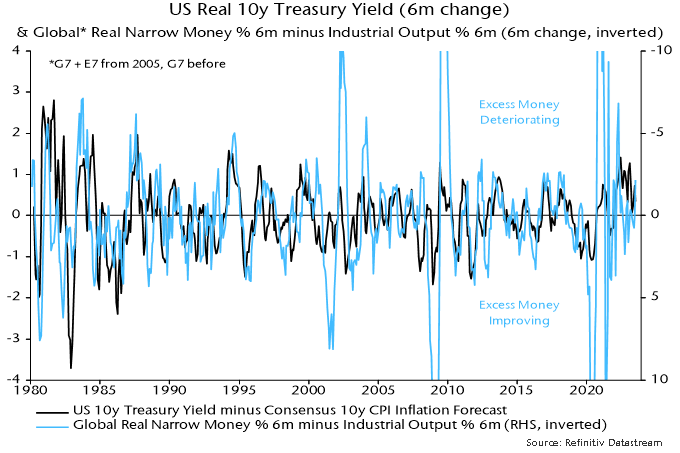
    Why have global government bond yields picked up over the summer despite weakening PMIs and neutral / favourable inflation news? 

    The rise is attributed here to a further deterioration in the global “excess” money backdrop driven partly by unexpected output strength as an easing of supply constraints has allowed firms to work off order backlogs. Output is expected to realign with weak / falling incoming demand during H2, suggesting a reversal of liquidity tightening. 

    The rise in nominal yields has been driven by the real component with inflation expectations little changed. 

    Changes in real yields have been inversely correlated historically with changes in global “excess” money momentum, as measured by the differential between six-month rates of change of real narrow money and industrial output – see chart 1. 

    Chart 1

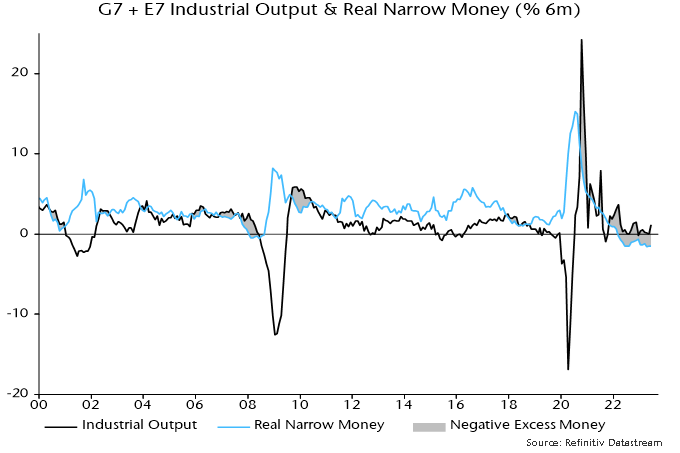
    This differential has been negative since early 2022 but was expected to narrow as monetary tightening fed through to weaker economic activity and slowing inflation lifted real money momentum. Instead, industrial output growth rose to a seven-month high in June while nominal money weakness has offset a disinflation boost to real momentum – see chart 2. 

    Chart 2

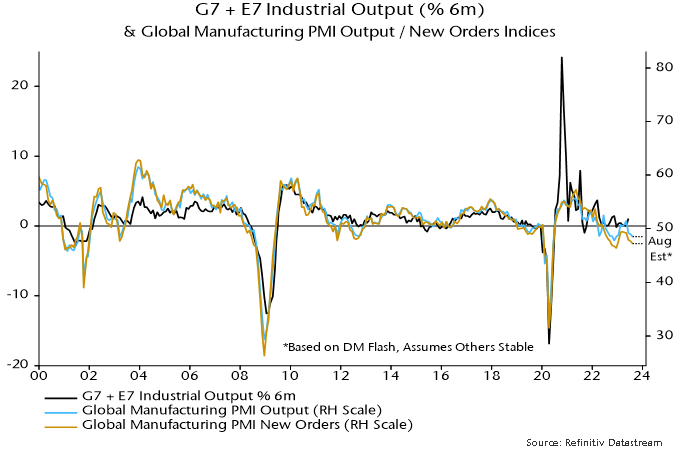
    Production resilience was signalled by a recovery in the global manufacturing PMI output index, which crossed 50 in February on the way to a May high. It moved back below breakeven in June / July, however, with August flash results suggesting a return to the December 2022 level or lower – see chart 3. 

    Chart 3

    Covid-related supply disruption resulted in the PMI output index lagging the new orders index in 2021 / H1 2022, but the position has reversed over the past year as production bottlenecks have eased, allowing firms to fulfil outstanding orders. 

    With the PMI delivery speed index – an inverse indicator of bottlenecks – hitting a 14-year high in May, the supply catch-up is probably ending, suggesting that the PMI output index – and hard production data – will converge with weaker new orders. At the current level of the latter index, this would imply output contraction. 

    The real narrow money / industrial output momentum differential, therefore, is likely to narrow unless nominal money data weaken further and / or consumer price inflation rebounds (unlikely). While G7 tightening is still feeding through, stable / easier monetary policies are expected to promote money growth recoveries in EM

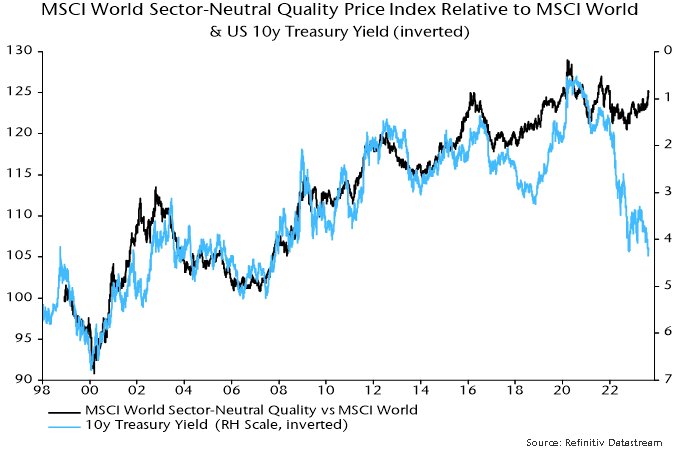
    Commentaries here have suggested that the monetary / economic backdrop would favour quality stocks in 2023. The MSCI World quality index is 7.1% ahead of MSCI World in price terms year-to-date (as of yesterday’s close). This mainly reflects a high weighting in tech, but the sector-neutral quality index (which imposes MSCI World sector weights) is also now outperforming the main index and has reversed its relative weakness in 2022 – see chart 4. 

    Chart 4

    The recent relative gain is striking against the backdrop of rising Treasury yields, with which the style has been inversely correlated historically, as the chart shows. The divergence is reminiscent of 2018, when the quality relative embarked on a sustained rise in February but a fall in Treasury yields was delayed until November. This year’s quality rally also started in February, suggesting a resolution of the current disconnect with yields by year-end.

  • Chinese weakness due to policy misstep

    Pessimistic commentators argue that the Chinese economy has entered a “liquidity trap” and faces Japan-style deflation. This assessment is not shared here: a recent monetary slowdown can be explained by misguided policy tightening around end-2022, which is now being reversed, while broad money growth would need to fall much further to suggest a sustained decline in prices. 

    A review of monetary policy in recent years is helpful in understanding current conditions. An important consideration is that – like the Fed decades ago – the PBoC does not announce changes in its policy stance, which often become apparent only after the event in movements in money market rates and credit / monetary trends. 

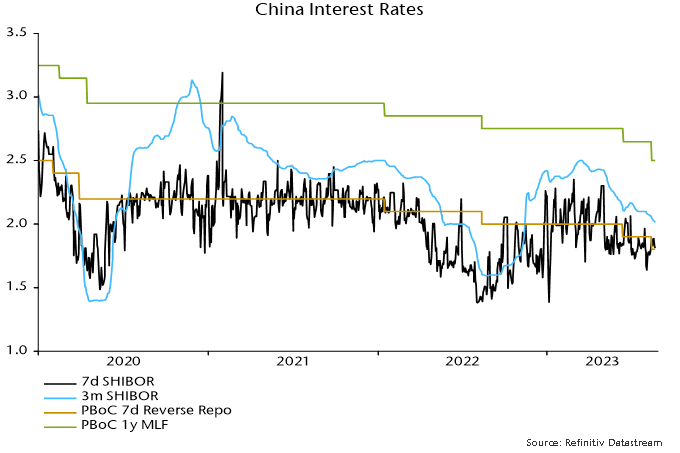
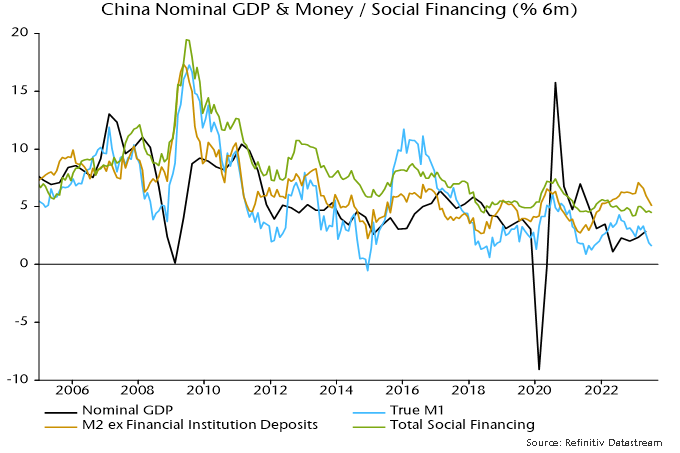
    The PBoC eased policy between late 2020 and summer 2022 to cushion covid-related economic weakness. Three-month SHIBOR fell from over 3% to 1.5%, while six-month growth rates of money and credit began to pick up from mid-2021 – see charts 1 and 2. 

    Chart 1

    Chart 2

    Narrow and broad money measures continued to accelerate in H1 2022, laying the foundations for a solid post-reopening economic recovery in H1 2023 – real GDP grew by 6.1% annualised between Q4 2022 and Q2 2023. 

    The PBoC, however, blotted its copy book in late 2022, tightening policy on misplaced concern about a reopening-driven inflation pick-up, although narrow money and credit growth were by then cooling and the ratio of broad money to nominal GDP was close to trend (in contrast to the US / Europe, where a large monetary overhang fuelled strong price pressures). 

    Three-month SHIBOR rebounded from 1.7% in September to 2.4% by year-end, rising further to 2.5% in March. The consensus view at the time – not shared here – was that the rise in money rates reflected stronger money demand due to reopening, i.e. the increase was “endogenous” rather than policy-driven and would not threaten economic prospects. 

    Policy tightening has resulted in six-month narrow and broad money growth falling to late 2021 levels, although credit expansion has declined by less (despite a very weak July flow number) – chart 2. The monetary slowdown suggests a loss of economic momentum through late 2023.

    The PBoC has, at least, been swift to recognise its error, resuming easing in early Q2. Three-month SHIBOR has retraced half of its August-March rise but may need to return to the low to offset recent monetary damage. 

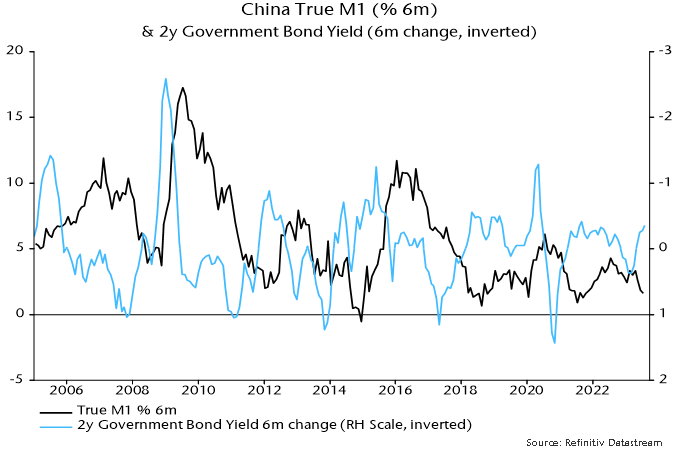
    Chart 3 illustrates the inverse leading relationship between changes in interest rates (in this case the two-year government yield) and narrow money momentum. The reversal in rates suggests a bottoming out and revival in money momentum, although timing is uncertain. 

    Chart 3

    Why did Japan enter a sustained deflation in the early 1990 and are there parallels with current Chinese conditions? 

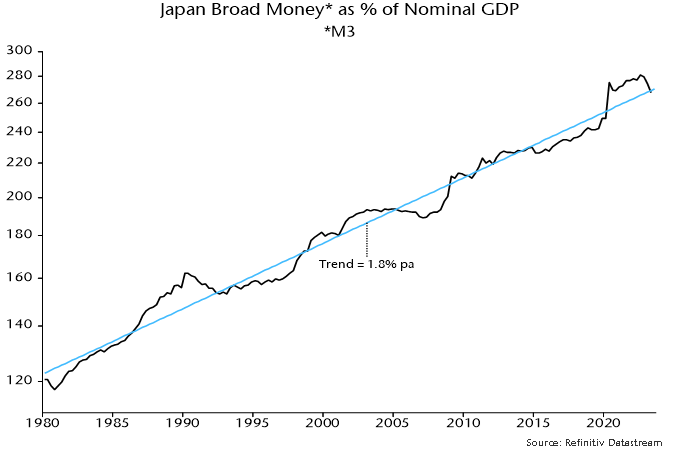
    From a monetary perspective, a deflationary environment requires (broad) money growth to fall below the sum of trend real GDP growth and the trend rise in the money / nominal GDP ratio. 

    The ratio of Japanese broad money M3 to nominal GDP has risen by 1.8% pa on average over the long run – chart 4. Trend real GDP growth was running at about 2% in the early 1990s, so broad money needed to expand by about 4% pa to maintain stable prices. Annual growth fell below this level in 1991 on the way to zero in 1992, averaging 2.7% over 1991-2000. 

    Chart 4

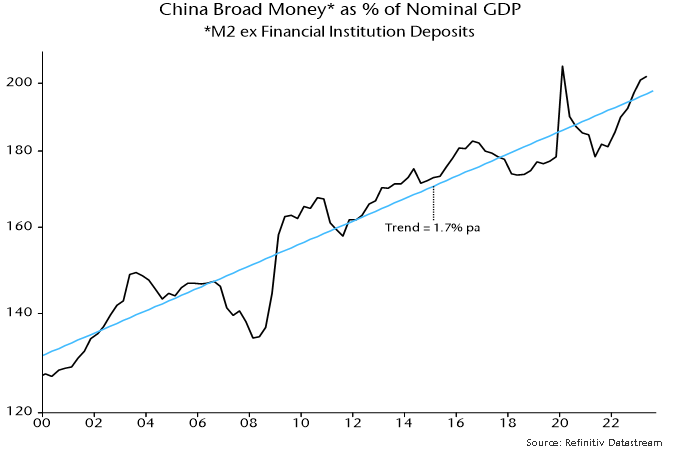
    China’s broad money to nominal GDP ratio has risen at a similar trend rate of 1.7% pa – chart 5. If trend real GDP growth is assumed to be about 5%, broad money expansion needs to stay above about 7% to avoid a deflationary scenario. Annual growth is currently 11.6%, with the six-month rate of increase at 10.4% pa. 

    Chart 5

    —–
    COMMENT:
    AUTHOR: David Cotton
    EMAIL:
    IP: 78.129.191.50
    URL:
    DATE: 08/23/2023 01:19:44 PM

    When will we see easing from other central banks I wonder?

    Rather concerningly the street view seems to be that ECB et al will merely skip a hike in September but still go ahead in October!

    To me this seems improbable, though that has also been true for much of the hiking cycle.

  • PMI / monetary data confirming global “double dip”

    A recovery in global economic momentum into the spring has gone into reverse, with monetary trends suggesting that weakness will intensify during H2. 

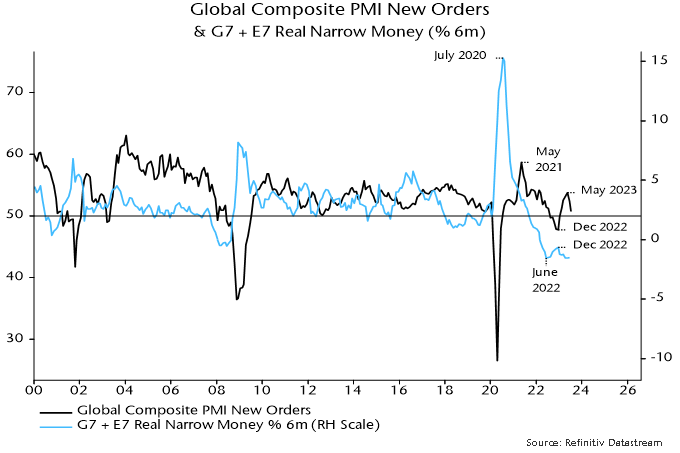
    The global composite PMI new orders index fell sharply again in July and has now retraced half of its December-May rise – see chart 1. The relapse was foreshadowed by a decline in global six-month real narrow money momentum from a local peak in December 2022. Real money momentum retested its June 2022 low in April and has since moved sideways, suggesting a further slide in the PMI index into early Q4 followed by stabilisation.

    Chart 1

    The December-May recovery in global PMI new orders was boosted by several non-monetary factors, including release of pent-up demand for services, China’s reopening and gas price relief in Europe. With similar tailwinds unlikely during H2, the orders index may retest or break the December 2022 low. 

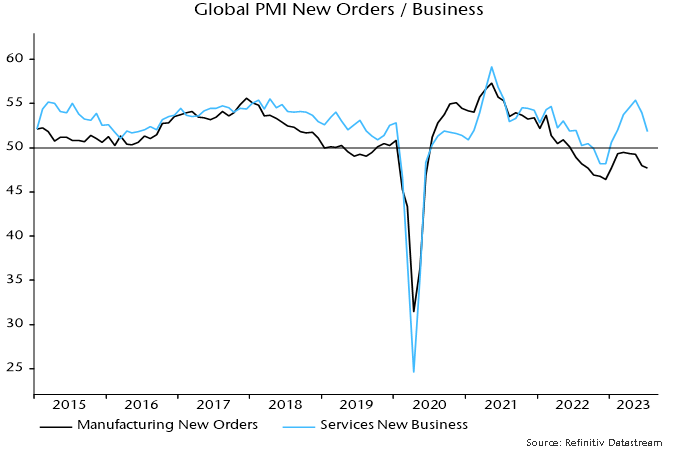
    The July orders decline was paced by a slowdown in services new business, although manufacturing demand also weakened further – chart 2. The services-manufacturing gap remains wide and is expected to close via the former moving into contraction, with manufacturing possibly stabilising as the stockbuilding cycle bottoms. 

    Chart 2

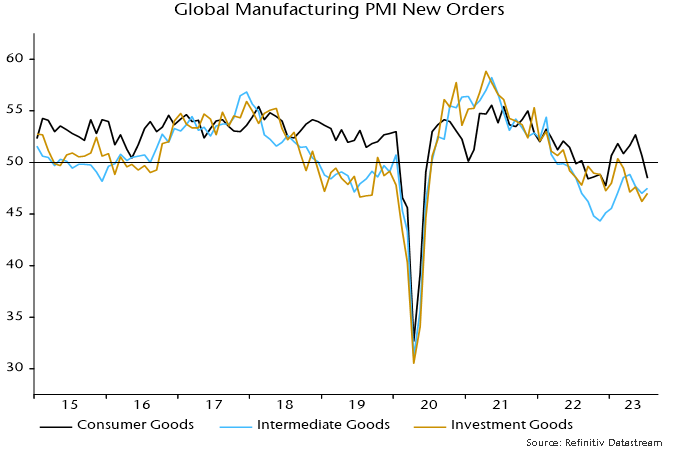
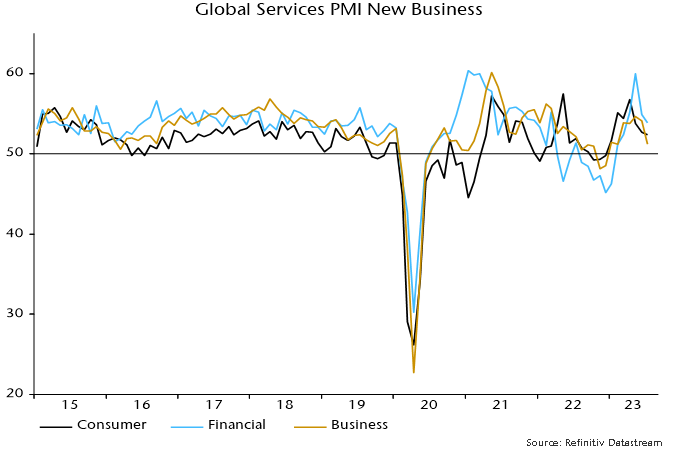
    The July PMI orders decline was broadly based across sectors. Within manufacturing, consumer goods joined investment and intermediate goods in contraction – chart 3. Services demand slowed across consumer, financial and business segments – chart 4. 

    Chart 3

    Chart 4

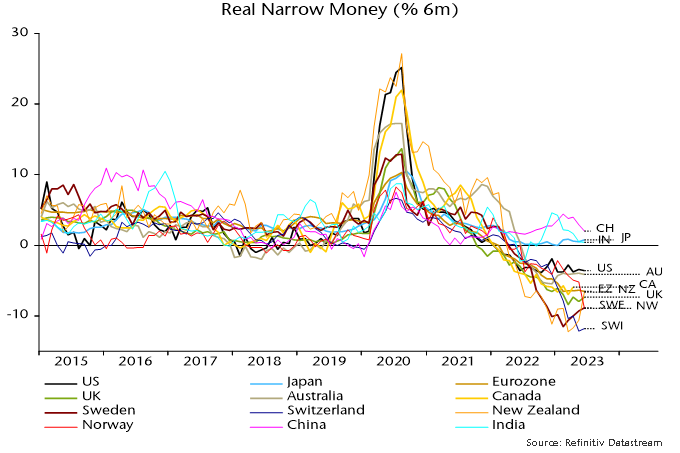
    Six-month real narrow money momentum remains weakest in Europe and has slowed in China and India – chart 5. With policy tightening still feeding through, and recent oil price strength acting to slow a decline in six-month CPI momentum, global real money momentum may fail to recover during Q3. 

    Chart 5

    —–
    COMMENT:
    AUTHOR: Steve
    EMAIL:
    IP: 24.206.97.26
    URL:
    DATE: 08/09/2023 07:30:14 AM

    Thanks Simon!

    Won't we see a general H2 macro recovery, as destocking ends and US ISM manufacturing new orders bounce back to around 55?

    —–
    COMMENT:
    AUTHOR: David Cotton
    EMAIL:
    IP: 78.129.191.50
    URL:
    DATE: 08/11/2023 01:05:59 PM

    Definitely concerning that the policy tightening so far surely hasn't fully impacted nominal money measure and that inflation will seemingly rise slightly as well.

  • Eurozone inflation on track for 2024 target return

    Eurozone CPI numbers for July were deemed disappointing because annual core inflation – excluding energy, food, alcohol and tobacco – stalled at 5.5%. 

    Or did it? The annual rise in the ECB’s seasonally adjusted core series slowed to 5.3%, below the consensus forecast of 5.4% for the Eurostat unadjusted measure. The two gauges rarely diverge to this extent (they both recorded 5.5% inflation in June). 

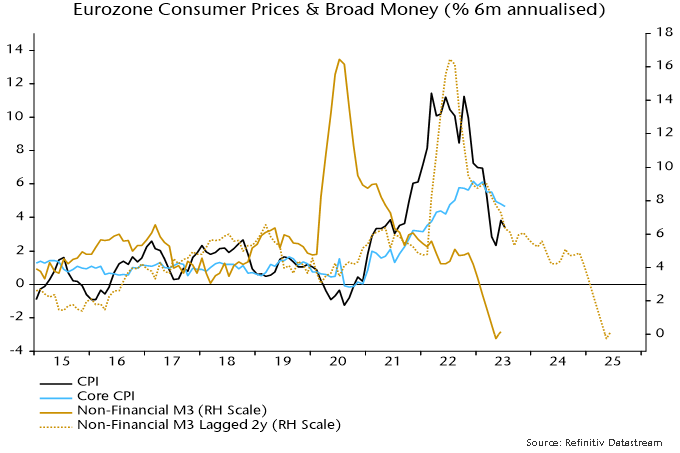
    The six-month rate of increase of the ECB series eased to 4.7% annualised in July, the slowest since June 2022 and down from a December peak of 6.2%. Six-month headline momentum was lower at 3.4%. 

    As in the UK, six-month headline inflation is tracking a simplistic “monetarist” forecast based on the profile of broad money momentum two years earlier – see chart 1. This relationship suggests that six-month CPI momentum will be back at about 2% in spring 2024, with the annual rate following during H2. 

    Chart 1

    The projected return to 2% next spring is a reflection of a fall in six-month broad money momentum below 5% annualised in spring 2022. A subsequent decline in money momentum to zero suggests an inflation undershoot or even falling prices in 2025. 

    The shocking implication is that monetary trends were already consistent with a return of inflation to target before the ECB started hiking rates in July 2022. The 425 bp rise since then represents grotesque overkill, confirmed by recent monetary stagnation / contraction. 

    The corollary is that a huge and embarrassing policy reversal is likely to be necessary over the next 12-24 months, unless some other factor causes broad money momentum to recover to a target-consistent pace. 

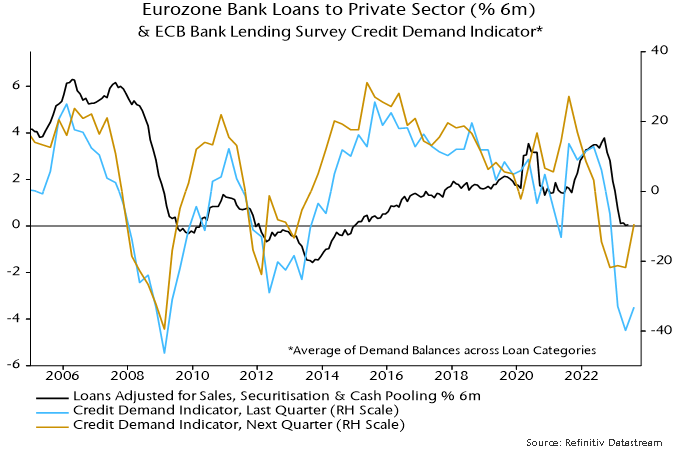
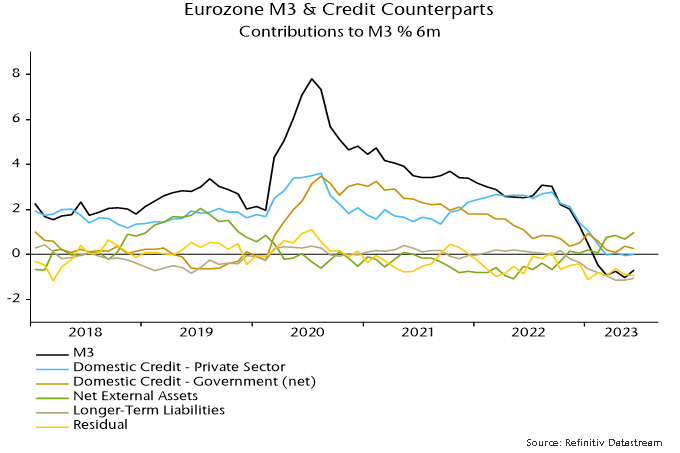
    That seems a remote possibility, based on consideration of the “credit counterparts”. Loan demand balances in the latest ECB bank lending survey were less negative but still suggestive of negligible private credit expansion – chart 2. 

    Chart 2

    Credit to government may contract given QT, withdrawal of TLTRO funding and inverted yield curves. (Banks previously used cheap TLTRO finance to buy higher-yielding government securities.) Redemptions of public sector debt held under the ECB’s Asset Purchase Programme amount to €262 billion over the next 12 months, equivalent to 1.6% of M3. 

    Broad money momentum has been supported recently by an increase in banks’ net external assets, reflecting a strengthening basic balance of payments (current account plus non-bank capital flows) – chart 3. This could accelerate as a Eurozone recession swells the current account surplus but is unlikely to outweigh domestic credit weakness. 

    Chart 3

    —–
    COMMENT:
    AUTHOR: David Cotton
    EMAIL:
    IP: 78.129.191.50
    URL:
    DATE: 08/08/2023 09:11:58 AM

    We should be wondering when falling inflation will positively impact real broad and narrow money growth?

    Nominal money growth falling faster than inflation is more of a problem than the inflation itself.

    When does the pivot come?

  • Why investors should fade a possible ISM bounce

    A bottoming out of the global stockbuilding cycle could be associated with a near-term recovery in manufacturing survey indicators. Money trends suggest that any revival will be modest / temporary and offset by wider economic weakness. 

    Economic news has been unusually mixed since end-2021, with GDP weakness contrasting with labour market strength and manufacturing deterioration offset by services resilience. Confusing signals have contributed to market hopes of a “soft landing”. 

    Sectoral and regional divergences may persist in H2 2023. The expectation here is that manufacturing survey weakness will abate but labour market data will worsen significantly. Money trends continue to cast strong doubt on soft landing hopes. Europe is likely to underperform the US. 

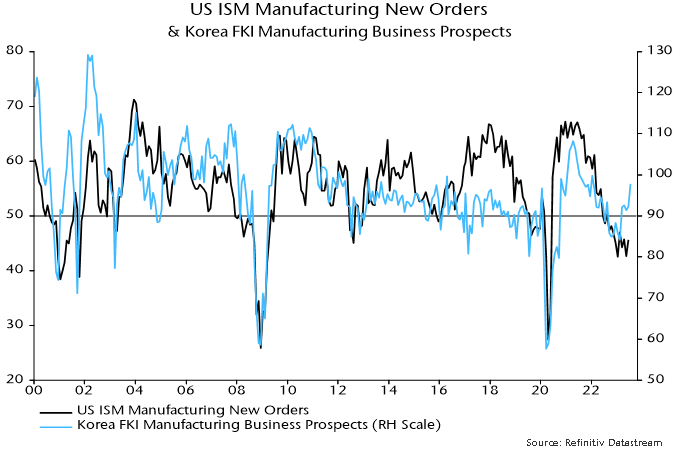
    The US ISM manufacturing new orders index – a widely watched indicator of industrial momentum – hit a low of 42.5 in January and retested this level in May before recovering to 45.6 in June. 

    Reasons for expecting a further rise include: 

    • The index has been in the 40s since September 2022 and the mean duration of sub-50 periods historically was eight months (ignoring episodes of three months or less). 

    • The global stockbuilding cycle remains on track to bottom out during H2 2023 and lows historically were usually preceded by a recovery in US / global manufacturing new orders. 

    • Recent price falls for raw materials and other production inputs may further incentivise firms to step up purchasing to maintain or replenish inventories.

    Korean manufacturing is a bellwether of US / global trends and the latest Federation of Korean Industries survey reported a marked improvement in optimism, consistent with ISM new orders moving back above 50 – see chart 1. 

    Chart 1

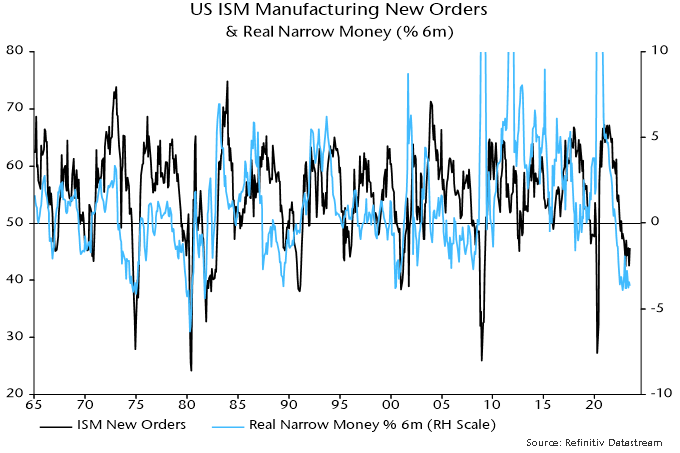
    Sustained recoveries in ISM new orders from the mid 40s into expansionary territory historically occurred against a backdrop of positive and / or rising six-month real narrow money* momentum. Current trends are unfavourable, with momentum still significantly negative and moving sideways – chart 2. 

    Chart 2

    Examples of recoveries to above 50 without a supportive monetary backdrop include 1970 and 1989-90. In both cases the rise was modest (peaking below 55), short-lived and followed by a decline to a lower low. The recovery in 1970 occurred within an NBER-defined recession and in 1989-90 just before one. 

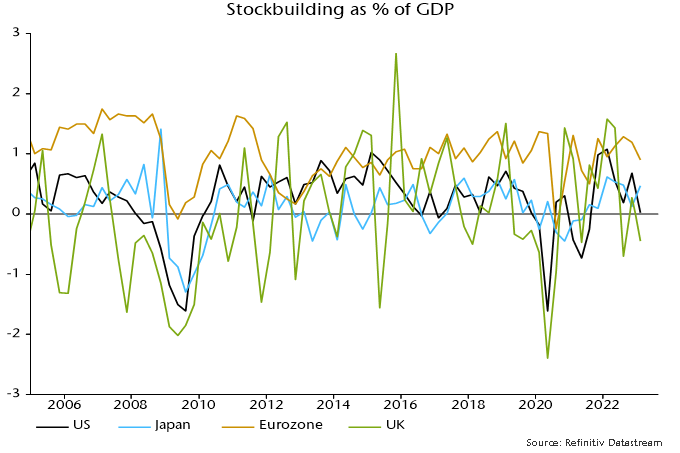
    An ISM rebound might not be mirrored by much if any revival in European manufacturing surveys. Money trends are even weaker than in the US, while the stockbuilding adjustment started later in the Eurozone and probably has further to run – charts 3 and 4. 

    Chart 3

    Chart 4

    *Narrow money definition used here = M1A = currency + demand deposits.

    —–
    COMMENT:
    AUTHOR: David Cotton
    EMAIL:
    IP: 78.129.191.50
    URL:
    DATE: 07/28/2023 10:51:16 AM

    Mixed because data from some regions will probably be revised quite negatively later? Combined with the fact that there is usually a 2 or 3 quarter lag from recession start to serious labour market declines?

    US NSA continuing claims in 2008 didn't rise 30% y/y until well in to H2 and they've already hit that level earlier in July.

    Ultimately we'll probably (seriously) regret not making more noise to stop central banks from continuing to raise rates even after recession most probably already started in the present cycle

  • Why UK inflation underperformance could be ending

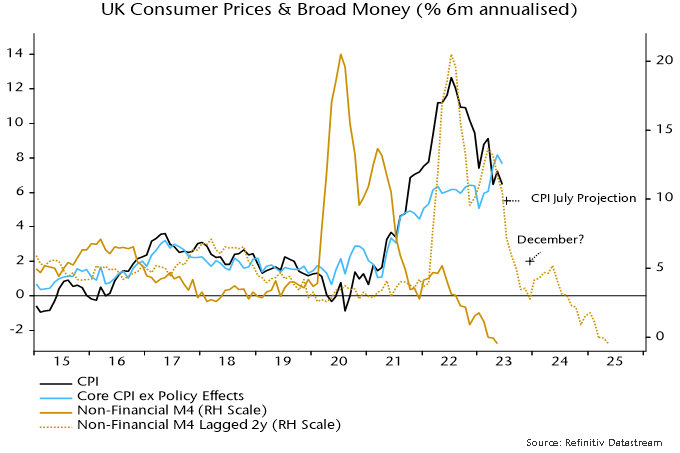
    UK headline CPI momentum continues to track a simplistic “monetarist” forecast based on the profile of broad money momentum two years earlier. 

    Six-month growth of headline prices, seasonally adjusted, peaked at 12.7% annualised in July 2022 and had halved to 6.5% as of June. This mirrors a halving of six-month broad money momentum from a peak of 20.5% annualised in July 2020 to 10.5% in June 2021 – see chart 1. 

    Chart 1

    Broad money continued to slow sharply during H2 2021, with six-month momentum down to 2.7% by December, suggesting a fall in six-month CPI momentum to 2% annualised or lower by late 2023 / early 2024. 

    A 2% rate of increase of prices during H2 2023 could be achieved by the following combination: 

    The energy price cap falling by a further 10% in October, in line with current estimates based on wholesale prices, following the 17% July reduction. 

    Food, alcohol and tobacco prices slowing to an 8% annual inflation rate by December from 14.9% in June. 

    Core prices rising at a 4% seasonally adjusted annualised rate during H2 2023, down from 7.7% in H1. 

    The latter two possibilities are supported by producer output price developments – annual inflation of food products is already down from a 16.8% peak to 8.7%, while core output prices flatlined during H1, following a 6.4% annualised rise during H2 2022. 

    A 2% annualised CPI increase during H2 2023 would imply a headline annual rate of about 4% by year-end, well with PM Sunak’s target of a halving from 10%+ levels, although he will have made no contribution to the “success”. 

    Why has UK CPI inflation exceeded US / Eurozone levels, both recently and cumulatively since end-2019? 

    The assessment here is that the divergence reflects relatively weak UK supply-side economic performance and a larger negative terms of trade effect, rather than more egregious monetary excess. 

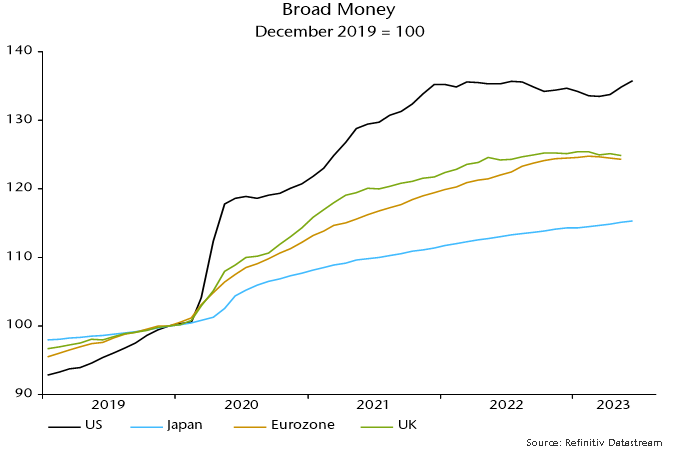
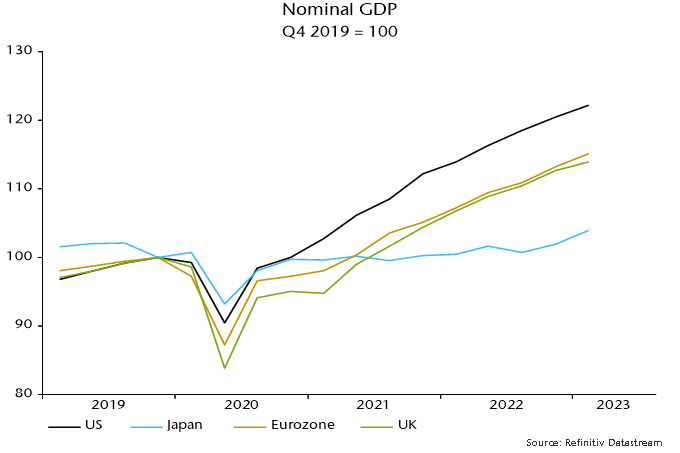
    Charts 2 and 3 show that UK / Eurozone broad money expansion since end-2019 has been similar and less than in the US, with the relative movements mirrored in nominal GDP outcomes. 

    Chart 2

    Chart 3

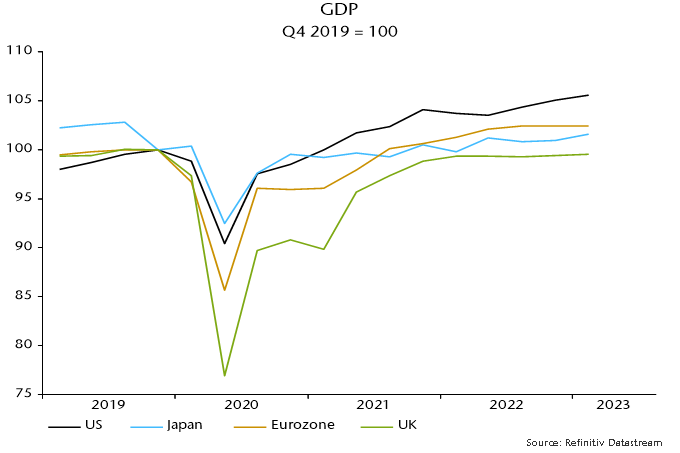
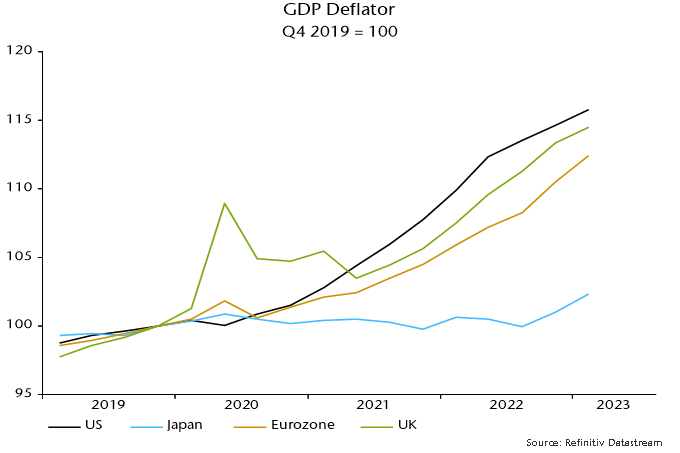
    The UK has, however, underperformed the US and Eurozone in terms of the division of nominal GDP expansion between real GDP and domestically-generated inflation, as measured by the GDP deflator – charts 4 and 5. 

    Chart 4

    Chart 5

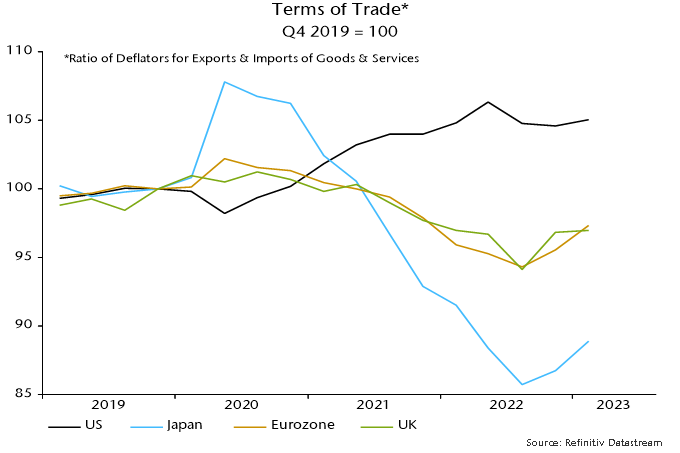
    UK consumer prices were additionally boosted relative to the US by opposite movements in the terms of trade (i.e. the ratio of export to import prices), reflecting different exposures to energy prices as well as currency movements (i.e. a strong dollar through last autumn) – chart 6. 

    Chart 6

    UK supply-side weakness may be structural but monetary and terms of trade considerations suggest an improvement in UK relative inflation performance – annual broad money growth is now similar to the US and below the Eurozone level, while sterling appreciation since late 2022 may extend a recent recovery in the terms of trade.

    —–
    COMMENT:
    AUTHOR: David Cotton
    EMAIL:
    IP: 86.141.250.253
    URL:
    DATE: 07/25/2023 08:51:49 AM

    I think we need to be careful comparing different countries CPI within small margins at relatively high absolute level.

    A couple of % can be accounted for by different methodology or a slightly different CPI basket.